 CFA Society Of Toronto - Home Page




The Hedge Fund Mirage: The Illusion of Big Money and Why it’s Too Good to be True
Simon Lack
Wiley, $41.95
Drawing on his insider view during the 1990s, a time when hedge fund investors did well in part because there were relatively few of them, Simon Lack, the author of The Hedge Fund Mirage, chronicles the early days of hedge fund investing, describes the seeding business, a specialized area in which investors provide venture capital-type funding to promising but undiscovered hedge funds; reveals the surprising frequency of fraud, highlighted with several examples that Simon Lack was able to avoid through solid due diligence, industry contacts, and luck; and examines why new and emerging hedge fund managers are where generally better returns are to be found, because most capital invested is steered towards apparently safer but less profitable large, established funds.
The book also demonstrates how to identify the good hedge funds and keep more of the winnings that are generated using their capital. Lack advises hedge fund investors to invest the way they did in the 1990s: look for smaller funds that are not well followed and utilize obscure and off-the-beaten-track strategies. The vast majority of hedge funds did better when they were smaller, and so did the industry as a whole. Careful due diligence is necessary to ensure the quality of returns, valuation procedures and other qualitative metrics are acceptable.
Currency Wars: The Making of the Next Global Crisis
Bill Bonner
James Rickards, $31.00
Currency wars have happened before-twice in the last century alone-and they always end badly. Time and again, paper currencies have collapsed, assets have been frozen, gold has been confiscated, and capital controls have been imposed. And the next crash is overdue. Recent headlines about the debasement of the dollar, bailouts in Greece and Ireland, and Chinese currency manipulation are all indicators of the growing conflict.
As James Rickards argues in Currency Wars, this is more than just a concern for economists and investors. The United States is facing serious threats to its national security, from clandestine gold purchases by China and the hidden agendas of sovereign wealth funds.
While the outcome of the new currency war is not yet certain, some version of the worst-case scenario is almost inevitable if U.S. and world economic leaders fail to learn from the mistakes of their predecessors. Rickards untangles the web of failed paradigms, wishful thinking, and arrogance driving current public policy and points the way toward a more informed and effective course of action.
The Handbook of Equity Market Anomalies: Translating Market Inefficiencies into Effective Investment Strategies
Len Zacks
Wiley, $90.00
The Handbook of Equity Market Anomalies organizes and summarizes research carried out by hundreds of finance and accounting professors over the last twenty years to identify and measure equity market inefficiencies and provides self-directed individual investors with a framework for incorporating the results of this research into their own investment processes. Edited by Len Zacks, CEO of Zacks Investment Research, and written by leading professors who have performed ground-breaking research on specific anomalies, this book succinctly summarizes the most important anomalies that savvy investors have used for decades to beat the market.
Thinking Fast and Slow
Daniel Kahneman
Doubleday Canada, $34.00
Engaging the reader in a lively conversation about how we think, Kahneman reveals where we can and cannot trust our intuitions and how we can tap into the benefits of slow thinking. He offers practical and enlightening insights into how choices are made in both our business and our personal lives – and how we can use different techniques to guard against the mental glitches that often get us into trouble. Thinking, Fast and Slow will transform the way you think about thinking.
Kahneman takes us on a ground-breaking tour of the mind and explains the two systems that drive the way we think. System 1 is fast, intuitive, and emotional; System 2 is slower, more deliberative, and more logical. Kahneman exposes the extraordinary capabilities – and also the faults and biases – of fast thinking, and reveals the pervasive influence of intuitive impressions on our thoughts and behaviour.
Manias, Panics and Crashes: A History of Financial Crises
Robert Z. Aliber, Charles Kindleberger, Robert Solow
Palgrave Macmillan, $23.00
Selected as one of the best investment books of all time by the Financial Times, Manias, Panics and Crashes puts the turbulence of the financial world in perspective. Here is a vivid and entertaining account of how reckless decisions and a poor handling of money have led to financial explosions over the centuries. In this new, updated sixth edition, Kindleberger and Aliber expand upon the ideas presented in the previous edition to bring the history of the financial crisis up-to-date. It now includes two new chapters that provide an in-depth analysis of the causes, consequences and policy responses to the first global crisis of the 21st century, the financial crisis of 2007-2008. In addition, these new chapters also cover significant crises of the last fifteen years. The authors offer valuable lessons that will allow the reader to successfully navigate the financial crises of today and ones that lie ahead.
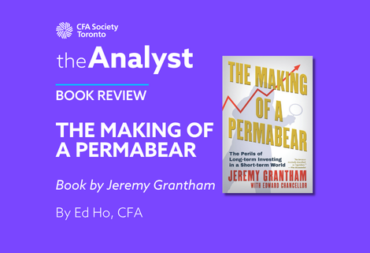 The Making of a Permabear by Jeremy Grantham Books to help you step into spring BOOKS TO BRING YOU INTO A NEW YEAR