 CFA Society Of Toronto - Home Page





The Little Book of Commodity Investing
John Stephenson
Wiley, $23.95
The Little Book of Commodity Investing is an indispensable guide to learning the ins and outs of commodity investing. It explains the benefits of commodities as part of a well diversified investment portfolio; covers all of the major commodities markets; what makes commodities and the companies that produce them tick; why commodities sometimes zig and then zag; what to buy and when to buy it; and why commodities are the next big thing. Today’s world is a very different world-a world where an understanding of commodities is a prerequisite for investment success.
The Little Book of Sideways Markets: How to Make Money in Markets that Go Nowhere
Vitaliy N. Katsenelson
Wiley, $23.95
Respected value investor and author Vitaliy Katsenelson shows you how to survive a stagnant market that’s neither bull nor bear but instead what he calls a cowardly lion– it displays occasional bursts of bravado but is ultimately overcome by fear. Katsenelson, known for the common-sense principles he has written frequently about in the Financial Times, Bloomberg Businessweek and elsewhere, decodes the theories and cuts to the chase with practical and timely strategies for how you can survive and thrive during a sideways market-a state of affairs, which, by the way, we should expect for the next decade.
Why We Hate the Oil Companies: Straight Talk from an Energy Insider
John Hofmeister
Palgrave McMillan, $32.00
As president of Shell Oil, John Hofmeister was known for being a straight shooter, willing to challenge his peers throughout the industry. Now, he’s a man on a mission, the founder of Citizens for Affordable Energy, crisscrossing the country in a grassroots campaign to change the way we look at energy. Hofmeister offers an insider’s view of what’s behind the energy companies’ posturing, and how politicians use energy misinformation, disinformation, and lack of information to get and stay elected. He tackles the energy controversy head-on, without regard for political correctness. He also provides a new framework for solving difficult problems, identifying solutions that will lead to a future of comfortable lifestyles, affordable and clean energy, environmental protection, and sustained economic competitiveness.
Ethical Oil: The Case for Canada’s Oil Sands
Ezra Levant
McClelland and Stewart, $29.99
While many North Americans may be aware of the financial and environmental price we pay for a gallon of gas or a barrel of oil, Levant argues that it is time we consider ethical factors as well. With his trademark candor, Levant asks hard-hitting questions: With the oil sands at our disposal, is it ethically responsible to import our oil from the Sudan, Russia, and Mexico? How should we weigh carbon emissions with human rights violations in Saudi Arabia? And assuming that we can’t live without oil, can the development of energy be made more environmentally sustainable? Ethical Oil is a timely, engaging examination of Canada’s oil sands that makes for provocative reading on a subject that is in the headlines every day.
Planet Water: Investing in the World’s Most Valuable Resource
Steve Hoffmann
Wiley, $47.95
In Planet Water, Hoffmann, one of the first investors to recognize the value of the water industry as a long-term investment, reveals the details behind this growing opportunity. The water industry, Hoffmann explains, not only encompasses all aspects of drinking water, but also, in an increasingly significant context, provides water to meet the quality parameters of everything from human consumption to ecological integrity to semiconductor manufacturing to irrigation-and in the quantities necessary to potentially serve a future megacity of a billion people.
Gold Diggers: Striking it Rich in the Klondike
Charlotte Gray
Harper Collins, $34.99
The Gold Rush bred its own glittering mythology but Charlotte Gray has sifted through the legends to see who really won and lost in the race to get rich quick. Gold Diggers enables us to step effortlessly into the past, taking readers on an unforgettable journey into a world gone mad for wealth.
A Call for Judgment: Sensible Finance for a Dynamic Economy
Amar Bhide
Oxford University Press, $31.95
A Call for Judgment is both a primer on the role of finance in a dynamic modern economy, and a cautionary tale about the pitfalls of banks functioning as highly centralized, mechanistic entities. It is essential reading for anyone interested in bringing the economy back to a point at which decisions can be made that foster organic economic growth without the potentially disastrous risks currently accepted by modern finance.
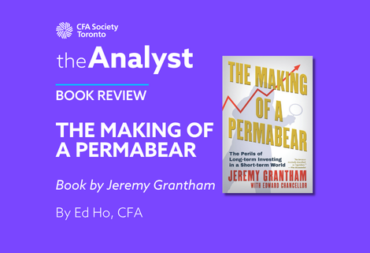 The Making of a Permabear by Jeremy Grantham Books to help you step into spring BOOKS TO BRING YOU INTO A NEW YEAR