 CFA Society Of Toronto - Home Page




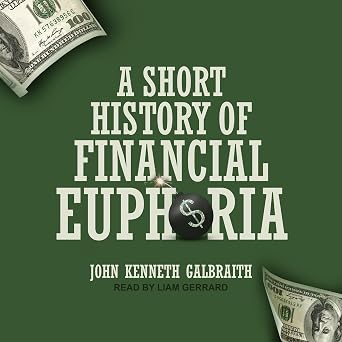
A Short History of Financial Euphoria, by John Kenneth Galbraith
Nvidia is now worth more than US$5 trillion, more than the annual output of every country on earth except the United States and China. In 2025, firms with some plausible tie to artificial intelligence supplied roughly four-fifths of the American stock market’s gains, and the 10 largest companies came to represent about 35 per cent of the S&P 500, a concentration last seen at the dot-com peak.
The tell, as always, is the spending. OpenAI has committed some US$1.4 trillion to data centres over eight years while booking roughly $13 billion in revenue, a ratio that would embarrass a lemonade stand were it not marketed as vision. A February 2026 study from the National Bureau of Economic Research put the same questions to nearly 6,000 senior executives: what AI has done for you, and what you expect it to do? Nine in 10 reported no effect on employment or productivity at their own firms to date. The same executives forecast productivity gains roughly five times what they had actually seen, a ratio that increases to nine times in the responses of American executives.
In A Short History of Financial Euphoria, Galbraith argued that the mechanics of a bubble never change.
None of this would have surprised John Kenneth Galbraith. In A Short History of Financial Euphoria, Galbraith argued that the mechanics of a bubble never change. “The circumstances that induce the recurrent lapses into financial dementia,” he wrote, “have not changed in any truly operative fashion since the Tulipomania of 1636 to 1637.” What recurs is not the asset but the state of mind: the satisfaction of getting rich, and the conviction that anyone getting rich must be clever. Prices rise, the rise is read as proof of genius, and the buying continues until no buyers remain. Although this book was published over 36 years ago in 1990 it still holds relevance for today’s markets.
His sharpest observations concern innovation. Strip away the marketing, he says, and every financial marvel reduces to the same act: “The creation of debt secured in greater or lesser adequacy by real assets.” Only the costume changes: bank notes printed against gold that was not there, stock bought on a 10 per cent margin in the 1920s, the leveraged buyouts and honestly named junk bonds of the 1980s. Each generation is certain it has invented something; each has merely rediscovered leverage in another form. The oldest rule on Wall Street, in Galbraith’s telling, is that financial genius is merely a rising market.
Consider the 1928 vintage shared in the 1929 chapter of Euphoria. The Goldman Sachs Trading Corporation issued stock to buy stock, then conjured Shenandoah, which conjured Blue Ridge, each owning the one beneath it in a tidy pyramid of borrowed enthusiasm. The Trading Corporation’s own shares ran from US$104 to $222.50 within months, then to $1.75 by 1932. The modern version travels under a name built to reassure: private credit. Lending has migrated out of the regulated banks into funds that borrow to lend, lever the fund itself, and repackage the loans into private collateralized obligations familiar to anyone who lived through 2008.
The numbers today are not small. Direct-lending assets stand near $1.8 trillion, closer to $3 trillion once undrawn commitments are counted. Morgan Stanley predicts that, of the roughly $3 trillion the world will spend building AI data centres by 2028, about half will be financed by private credit; the two great enthusiasms of the age are now strapped to each other. The International Monetary Fund flagged “multiple layers of leverage” and “stale and potentially subjective valuations,” but was ignored until the loans began to misbehave.
In late 2025, the auto parts maker First Brands failed, and lenders who believed they had financed it at five times leverage found the real figure closer to 20 once its off-balance-sheet borrowing surfaced; its senior loans now trade at about a third of face value. Weeks earlier, the subprime lender Tricolor collapsed amid allegations that it pledged the same collateral to several lenders at once, an innovation with four centuries of precedent, and its AAA-rated paper fell to about 12 cents on the dollar. Jamie Dimon supplied the review: when you see one cockroach, there are probably more.
Galbraith insists these episodes never end gently, that the crash is always accompanied by “a desperate and largely unsuccessful effort to get out.
In A Short History of Financial Euphoria, Galbraith insists these episodes never end gently, that the crash is always accompanied by “a desperate and largely unsuccessful effort to get out.” There are signs the tide may be turning. In early 2026, Blackstone’s flagship non-traded credit fund received about $3.7 billion in redemption requests, nearly ten per cent of net asset value, against a cap that generously permits five per cent a quarter. And because no euphoria is complete without fresh buyers, regulators have cleared private-credit managers to sell into the $13 trillion defined-contribution retirement system, introducing the American 401(k) to an asset class it cannot easily exit.
The reassurance has arrived on schedule. The failures, we are told, are idiosyncratic, matters of fraud rather than of the system. Galbraith catalogued this reflex: the urge to normalize each mania as a routine turn of the business cycle, and the theological insistence that the market is sound and any fault lies outside it. In 1926, the culprit was a pair of Caribbean hurricanes; after the 1987 crash, the federal budget deficit; in 2026, a handful of bad actors. The one suspect rarely questioned is the speculation itself.
Which brings us to Galbraith’s most useful number. Financial memory, he judged, lasts about 20 years, the time it takes for one disaster to fade and a new generation to arrive, sure of its own originality. The 2008 crisis is now 18 years behind us. The people who built today’s private-credit market did not underwrite through the last crisis, and the market they built has never been tested by a full default cycle.
Galbraith declined to predict when each new reckoning would arrive, on the grounds that anyone who claims to know “does not know he doesn’t know.” The book will not give you the timing, only remind you that the next time a room of geniuses explains why the old rules no longer apply, you have read the chapter before and know how it ends.
A Short History of Financial Euphoria is worth reading for the pattern rather than the history. Galbraith’s argument is that euphoria is cyclical and endlessly costumed, from tulips to trusts to junk bonds to private credit, and that the costume is what fools each generation into believing the cycle has been repealed. Any investor who can name the current innovation will find it described here under an older name.
Written by
Areg Avetisyan, CFA, is a finance professional with over eight years of experience across institutional asset management, family office and capital markets. Areg has spent the last six years producing investment research, client communications and reporting for institutional and private clients. He is the founder of Cortex Partners Inc. and serves on the Strategic Content Creation and Editorial Committees of CFA Society Toronto.