 CFA Society Of Toronto - Home Page




Canada and Its Centennial and Sesquicentennial: Transformative Policy Then and Now
Peter John Loewen, Andrew Potter, and Carolyn Tuohy
University of Toronto Press, September 2018, $60.00
Tracing the past, present, and future of Canadian policy-making, Canada and Its Centennial and Sesquicentennial examines the country’s current and most critical challenges: the renewal of the federation, managing diversity, Canada’s relations with Indigenous peoples, the environment, intergenerational equity, global economic integration, and Canada’s role in the world. Scrutinizing various public policy issues through the prism of Canada’s sesquicentennial, the contributors consider the transformation of policy and present an accessible portrait of how the Canadian view of policy-making has been reshaped, and where it may be heading in the next 50 years.
At a Crossroads: Russia in the Global Economy
Sergey Kulik, Nikita Maslennikov, and Igor Yurgens
McGill-Queen’s University Press, November 2018, $32.00
Globalization proceeds apace, taking on new forms that impact global, economic, financial, and social processes. Interdependence is not simply strengthening the range of possibilities for national economies to participate in (and take advantage of) these developments, but expanding the opportunities that are available to them. The question is, how do states take advantage of these global developments? Russia is no exception.
Although Russia actively participates in the globalization process, it is, however, confronting greater economic, technological, structural, and institutional problems than other countries. At the same time, there’s dwindling hope for favourable conditions to continue in global energy markets, which are crucial to the Russian economy. These problems exist alongside the risk that the widening gap between Russia and other economies, in terms of economic performance and technological development and growth, will continue. Russia now stands at the crossroads of either overcoming or exacerbating these current challenges. The old model of Russian development has been exhausted and a new one must be chosen. Russia’s choice at this juncture will determine the future of its economic development for many years to come.
Millions, Billions, Zillions: Defending Yourself in a World of Too Many Numbers
Brian W. Kernighan
Princeton University Press, November 2018, $30.99
Numbers are impressive, intimidating, confusing, and often deliberately deceptive—especially when they’re really big. The media love to report on millions, billions, and trillions, but frequently make basic mistakes or present such numbers in misleading ways. And misunderstanding numbers can have serious consequences, since they can deceive us in many of our most important decisions, including how to vote, what to buy, and whether to make a financial investment.
Computer scientist Brian Kernighan teaches anyone—even diehard math-phobes—how to demystify the numbers that assault us every day.
With examples drawn from a rich variety of sources—including journalism, advertising, and politics—Kernighan demonstrates how numbers can mislead and misrepresent. In chapters covering big numbers, units, dimensions, and more, he lays bare everything from deceptive graphs to speciously precise numbers. And he shows how anyone—using a few basic ideas and lots of shortcuts—can easily learn to recognize common mistakes, determine whether numbers are credible, and make their own sensible estimates when needed.
Adam Smith: Father of Economics
Jesse Norman
Basic Books, September 2018, $42.00
Adam Smith (1723–1790) is now widely regarded as the greatest economist of all time. But what he really thought, and the implications of his ideas, remain fiercely contested. Was he an eloquent advocate of capitalism and individual freedom? A prime mover of “market fundamentalism”? An apologist for human selfishness? Or something else entirely?
Jesse Norman dispels the myths and caricatures, and provides a far more complex portrait of the man. Offering a highly engaging account of Smith’s life and times, Norman explores his work as a whole and traces his influence over two centuries to the present day. Finally, he shows how a proper understanding of Smith can help us address the problems of modern capitalism. The Smith who emerges from this book is not only the greatest of all economists but also a pioneering theorist of moral philosophy, culture, and society.
The Person You Mean to Be: How Good People Fight Bias
Dolly Chugh
HarperCollins, September 2018, $34.99
Many of us believe in equality, diversity, and inclusion. But how do we stand up for those values in our turbulent world? The Person You Mean to Be is the smart, “semi-bold” person’s guide to fighting for what you believe in.
Dolly Chugh reveals the surprising causes of inequality, grounded in the “psychology of good people.” Using her research findings in unconscious bias—as well as work across psychology, sociology, economics, political science, and other disciplines—she offers practical tools to respectfully and effectively talk politics with family, to be a better colleague to people who don’t look like you, and to avoid being a well-intentioned barrier to equality.
She argues that the only way to be on the right side of history is to be a good-ish—rather than good—person. Good-ish people are always growing. Second, she helps you find your “ordinary privilege”—the part of your everyday identity you take for granted, such as race for a white person, sexual orientation for a straight person, gender for a man, or education for a college graduate. This part of your identity may bring blind spots, but it’s your best tool for influencing change. Third, Chugh introduces the psychological reasons that make it hard for us to see the bias in and around us. She leads you from wilful ignorance to wilful awareness. Finally, she guides you on how, when, and whom to engage (and not engage) in your workplaces, homes, and communities. Her science-based approach is a method any of us can put to use in all parts of our lives.
Never Stop Learning: Stay Relevant, Reinvent Yourself, and Thrive
Bradley R. Staats
Harvard Business Review Press, June 2018, $41.50
Keep learning or risk becoming irrelevant. It’s a truism in today’s economy: the only constant is change. Technological automation is making jobs less routine and more cognitively challenging. Globalization means you’re competing with workers around the world. Simultaneously, the Internet and other communication technologies have radically increased the potential impact of individual knowledge.
Making Up Your Own Mind: Thinking Effectively Through Creative Puzzle-solving
Edward B. Burger
Princeton University Press, November 2018, $27.95
We solve countless problems—big and small—every day. With so much practice, why do we often have trouble making simple decisions—much less arriving at optimal solutions to important questions? Are we doomed to this muddle, or is there a practical way to learn to think more effectively and creatively? In this enlightening, entertaining, and inspiring book, Edward Burger shows how we can become far better at solving real-world problems by learning creative puzzle-solving skills using simple, effective thinking techniques.
Making Up Your Own Mind teaches these techniques—including how to ask good questions, fail and try again, and change your mind—and then helps you practise them with fun verbal and visual puzzles. The goal is not to quickly solve each challenge but to come up with as many different ways of thinking about it as possible. As you see the puzzles in ever-greater depth, your mind will change, helping you to become a more imaginative and creative thinker in daily life. And learning how to be a better thinker pays off in incalculable ways for anyone—including students, businesspeople, professionals, athletes, artists, leaders, and lifelong learners.
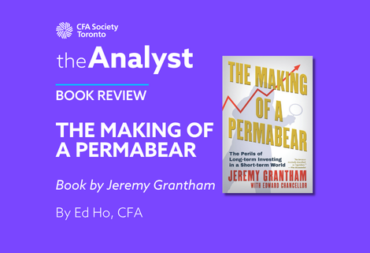 The Making of a Permabear by Jeremy Grantham Books to help you step into spring BOOKS TO BRING YOU INTO A NEW YEAR