 CFA Society Of Toronto - Home Page

- Events
- Overview Upcoming Events
 Candidate Connect LIVE!September 23, 2026
 FMI Learning Series: Using AI in financial modeling: What you need to know todaySeptember 29, 2026
 BEYOND PASSIVE BENCHMARK: Unlocking Multiple Sources of Alpha in Long-Duration Fixed IncomeOctober 7, 2026See All Events
- 69th Annual Investment Dinner

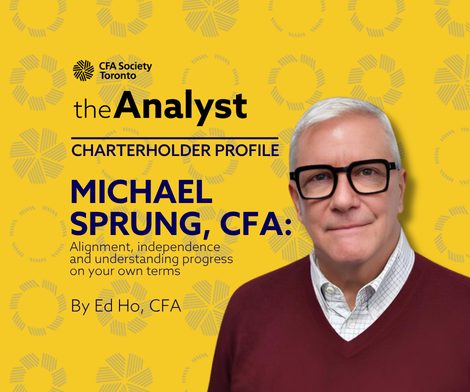
Alignment, independence andunderstanding progress on your own terms
What experience actually buys you
Careers in investment management are often described as journeys shaped by a series of decisions made under the constraints of the time. Markets change, institutions evolve and incentives shift, but the deeper challenge remains the same: how to exercise fiduciary judgment responsibly over long periods of time, often while resisting pressures to move faster, grow bigger or chase what appears to be working in the moment.
This article is a summary of a Q&A with Michael Sprung, CFA, and has been edited for length and clarity.
Michael Sprung’s career, spanning more than four decades, reflects a consistent commitment to that challenge. Over the course of his professional life, he has managed equity portfolios measured in the billions, worked inside large institutional environments and ultimately chosen independence to preserve alignment with his professional values. His path offers an instructive counterpoint to a profession increasingly driven by scale, speed and short horizons.
Michael Sprung, CFA, Career Highlights
• Founder and president, Sprung Investment Management Ltd. 2005
• Vice-president, Fiera/YMG Capital Management
• Vice-president, Goodman & Company
• Portfolio manager at OTTPB and Ontario Hydro
Volunteer experience:
- President, Rotary Club of Toronto Sunrise
- Chair and director, Bellwoods
- Director, Hearing Foundation Canada
- President, Genesis Club of Toronto
• CFA charterholder
• MBA, Western University; B. Math Actuarial Science, University of Waterloo
Learning markets the hard way
Sprung entered the investment industry in 1979, a formative period marked by volatility, institutional discipline and the lingering memory of how quickly markets can turn. Those early years coincided with events that left an imprint on an entire generation of investors: the 1982 recession, the 1987 market crash and, later, the rise and collapse of highly leveraged strategies such as Long-Term Capital Management. He also witnessed cycles of enthusiasm and disappointment, including the gold boom and bust of the late 1970s and early 1980s.
Markets, Sprung learned early on, are not abstract systems governed by elegant theories, but human environments shaped by fear, greed, leverage and narrative. Cycles repeat, though never in identical form, and recognizing them requires having seen not only success, but failure.
Managing capital on behalf of pensions and public-sector entities imposes a discipline that extends beyond performance metrics. Over the course of his career, Sprung developed a grounding in value-oriented thinking, influenced by Benjamin Graham, that emphasized intrinsic value, margin of safety and the importance of knowing when markets are drifting away from fundamentals.
Seeing the cycle before it repeats
One of the advantages of experience is the ability to detect recurring market dynamics. Having lived through multiple market cycles, Sprung developed an instinct for when enthusiasm begins to outrun reality. Debt-fuelled frenzies, sell-side product innovation designed to meet market fads rather than genuine investor needs and the seductive confidence of bull markets all become easier to spot with repetition.
This grounding has informed his investment temperament. Rather than reacting to every new narrative, Sprung learned to ask familiar questions: What assumptions are being made? Where is leverage building? What happens if expectations are wrong? These questions are not a guarantee of success, but they provide ballast when markets become euphoric or fearful. Importantly, this kind of judgment accumulates slowly, often uncomfortably, and often at odds with the prevailing mood of the moment. For Sprung, the value of experience lies not in predicting outcomes, but in identifying risk before it becomes obvious.
Choosing alignment over scale
In 2005, well into his career, Sprung made one of the more consequential decisions of his professional life: founding Sprung Investment Management. That decision was driven by a desire for alignment between client and institutional goals and more freedom to choose what’s right for his clients without organizational pressures. reach and brand, but they also impose constraints. Growth targets, sales pressures and internal politics can gradually distance decision-makers from the work that first drew them into the profession. For Sprung, independence offered a way to remain close to portfolio construction, client relationships and accountability.
The trade-offs were real. Running an independent firm meant assuming responsibility not only for investment decisions, but also for operations, compliance and the less visible burdens of entrepreneurship. Over the years, regulatory requirements have expanded significantly, increasing the cost and complexity of remaining independent. Compliance, once a manageable function, has become a major expense that favours scale and makes life more difficult for smaller, partner-owned firms.
Yet independence also brought clarity. Sprung could deliberately choose clients, align expectations honestly and avoid growth for its own sake. The firm he built was intentionally focused on private clients, non-profit organizations, endowments, foundations and small institutions. Its success would be measured by trust and continuity rather than solely by absolute asset growth.
Experience in an industry that prefers youth
Sprung’s decision to go independent also intersected with a reality that many professionals are reluctant to acknowledge openly: ageism remains a persistent feature of the investment industry. While experience is often praised in the abstract, it is frequently discounted in practice. Firms may choose to hire multiple younger professionals rather than a single seasoned investor, even when the latter brings judgment, historical perspective and the ability to foresee mistakes before they occur.
Success becomes less about maximizing personal upside and more about maintaining coherence, purpose and autonomy.
For Sprung, independence offered a way to step outside this dynamic. Rather than competing within organizational structures that undervalued experience, he chose a model that rewarded it directly. Control over his time, clients and process became increasingly important as he moved through his career. Decisions were framed in terms of his values and focus: taking care of his clients by providing high-quality investment advice. Success becomes less about maximizing personal upside and more about maintaining coherence, purpose and autonomy.
Learning to be visible without becoming someone else
One of the more human tensions in Sprung’s career is the contrast between his temperament and his public visibility. By his own description, he is an introvert. He does not enjoy marketing, self-promotion or sales in the conventional sense. And yet, over the years, he has become a familiar presence on business television and the financial press.
This was not a natural fit. Early media appearances were often uncomfortable, and he learned quickly that communication carries its own risks. An offhand remark or an imprecise phrase can have consequences. These experiences reinforced the importance of clarity, restraint and simplicity.
Sprung’s communication style evolved alongside his investment philosophy. Early in his career, like many professionals, he sometimes overcomplicated his explanations. With experience, he came to appreciate that the most respected investors explain their thinking plainly because clarity reflects understanding.
At this stage of my life, having control over my time, my clients and my process matters more than anything else.
Clients as partners
Independence also reshaped Sprung’s relationship with clients. In the early years of running his own firm, he did not have the luxury of being selective. Some client relationships were difficult, time consuming and misaligned. As the firm matured, he gained the ability to make more careful choices.
Today, Sprung views clients as partners rather than assets. Alignment matters. Investors seeking aggressive, high maintenance strategies are often better served elsewhere, and he is comfortable saying so. This selectivity is an acknowledgment that successful long term relationships depend on shared expectations and temperament.
FUN FACTS ABOUT MICHAEL
Early influence: Benjamin Graham- style value investing
First investment role: Research and portfolio work at Confederation Life
Career throughline: Buy-side investing across institutional, pension and independent settings
Most underestimated skill in investing: Patience
What experience teaches: Markets repeat, but the narratives change
Favourite investing principle: Simplicity over cleverness
Early media presence: One of the first guests on ROB-TV / BNN
What he’s doing outside the office: Cottage, photography and training a new rescue dog that hasn’t exactly warmed up to him
Why staying-power matters more than credentials
Sprung’s long involvement with the CFA community gives him perspective on how the profession has changed. Early in his career, the CFA designation was a clear differentiator. Today, it remains essential, but its role has shifted. It is often the price of entry rather than a guarantee of distinction.
In a more crowded and competitive field, standing out requires more than credentials. Judgment, communication and endurance matter. Looking back, Sprung reflects that he may have changed roles more often than necessary earlier in his career. Staying longer, he suggests, might have allowed for deeper learning and continuity.
Progress is not always measured by a higher salary or a fancier title. Sometimes, growth happens by patiently staying put long enough to understand the work, the culture and the consequences of decisions made over time.
Advice for young professionals
When asked what advice he would offer younger professionals, Sprung’s guidance is practical. Getting a foot in the door matters more than landing the ideal role immediately. Exposure, proximity to decision-making and learning on the job create opportunities and a foundation for future growth.
Equally important is recognizing that discomfort is part of the process. Sales, communication and public accountability are unavoidable, even for introverts. Careers reward those willing to step into discomfort to do what is necessary.
For Sprung, the defining feature of a successful career is not any single achievement, but coherence as a whole. For him, independence was one expression of that coherence. Wisdom ultimately emerged from learning to live with uncertainty and choosing a work environment that aligned with his values for the long terms.
Ed Ho, CFA, MSc, is an energy consultant specializing in strategy, policy and finance, focusing on the challenges and opportunities of the energy transition. He is a candid storyteller with the goal of driving consensus through fact-based diplomacy.