 CFA Society Of Toronto - Home Page





The Little Book of Economics: How the Economy Works in the Real World, 2nd Edition
Greg Ip
Wiley, $27.95
An accessible, thoroughly engaging look at how the economy really works and its role in your everyday life. not surprisingly, regular people are suddenly paying a lot closer attention to the economy than ever before. Short on technical jargon and long on clear, concise, plain-English explanations of important terms, concepts, events, historical figures, and major players, this revised and updated edition of Greg’s bestselling guide clues you in on what’s really going on, what it means to you, and what we should be demanding our policymakers do about the economy.
Guide to Commodities: Producers, Players and Prices
Caroline Bain
Wiley, $48.00 (publication date February 2013)
Written by the Senior Commodities Editor for the Economist Intelligence Unit, this book provides you with a comprehensive, highly practical look at the commodities markets. In addition to covering major trends and key changes in the markets, both past and present, it supplies you with proven tools for analyzing and taking full advantage of this ever-changing asset class. It focuses specifically on natural commodities classes, such as natural resources and raw materials, both mineral and agricultural, and describes how commodities prices have changed, both historically and in recent years, and how they are likely to change in future.
Financial Intelligence: A Manager’s Guide to Knowing What the Numbers Really Mean, Revised Edition
Karen Berman, Joe Knight and John Case
Harvard Business School Press, $27.00 (publication date February 2013)
Since its release in 2006, Financial Intelligence has become a favourite among managers who need a guided tour through the numbers—helping them to understand not only what the numbers really mean but also why they matter. This new, completely updated edition brings the numbers up to date and continues to teach the basics of finance to managers who need to use financial data to drive their business. It also addresses issues that have become even more important in recent years, including questions around the financial crisis and those around broader financial and accounting literacy.
Playing to Win: How Strategy Really Works
A.G. Lafley and Roger Martin
Harvard Business Review Press, $27.00 (publication date February 2013)
Drawn on their years of experience working together and separately at P&G and the Rotman School of Management, Lafley and Martin present a deceptively simple set of exercises and questions that can guide the decisions of anyone in an organization. The book helps you and those who work with you to figure out the relationship of the day-to-day work to larger strategic goals. If strategy is about creating a competitive advantage that allows a firm to win, then pinpointing your strategy to a few critically important choices will dramatically increase your chances of success. Playing to Win is a strategy book for everyone who works everywhere.
The Million-Dollar Financial Services Practice: A Proven System for Becoming a Top Producer, 2nd Edition
David J. Mullen
AMACOM, $30.00 (publication date February 2013)
Other books have claimed to help readers build a lucrative financial services practice, but it was The Million-Dollar Financial Services Practice that provided ambitious financial advisors with a step-by-step, tactical process proven to work. The second edition is updated throughout and contains new strategies for acquiring affluent clients and assets. Packed with templates, scripts, letters, and tried-and-true Market Action Plans, the book provides readers with the tools and guidance they need.
Prize Winners
These two titles were nominated for the Financial Times and Goldman Sachs Business Book of the Year Award.
The Hour Between Dog and Wolf: Risk Taking, Gut Feelings and the Biology of Boom and Bust
John Coates
Random House of Canada, $29.95
The laws of financial boom and bust, it turns out, have a lot to do with male hormones. In a series of startling experiments, Canadian scientist Dr. John Coates identified a feedback loop between testosterone and success that dramatically lowers the fear of risk in men, especially young men. He has vividly dubbed the moment when traders transform into exuberant high flyers, “the hour between dog and wolf.” Similarly, intense failure leads to a rise in levels of cortisol, which dramatically lowers the appetite for risk. His book expands on his seminal research to offer lessons from the exploding new field of the biology of risk. A successful Wall Street trader turned Cambridge neuroscientist reveals the biology of financial boom and bust, showing how risk-taking transforms our body chemistry, driving us to extremes of euphoria or stressed-out depression.
What Money Can’t Buy: The Moral Limits of Markets
Michael J. Sandel
Farrar, Straus and Giroux, $29.95
In What Money Can’t Buy, Michael J. Sandel takes on one of the biggest ethical questions of our time: is there something wrong with a world in which everything is for sale? If so, how can we prevent market values from reaching into spheres of life where they don’t belong? What are the moral limits of markets? In recent decades, market values have crowded out non-market norms in almost every aspect of life—medicine, education, government, law, art, sports, even family life and personal relations. Without quite realizing it, Sandel argues, we have drifted from “having” a market economy to “being” a market society. Is this where we want to be? He provokes an essential discussion that we, in our market-driven age, need to have: What is the proper role of markets in a democratic society—and how can we protect the moral and civic goods that markets don’t honour and that money can’t buy?
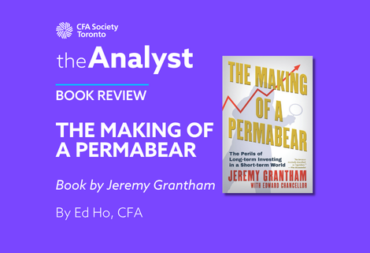 The Making of a Permabear by Jeremy Grantham Books to help you step into spring BOOKS TO BRING YOU INTO A NEW YEAR